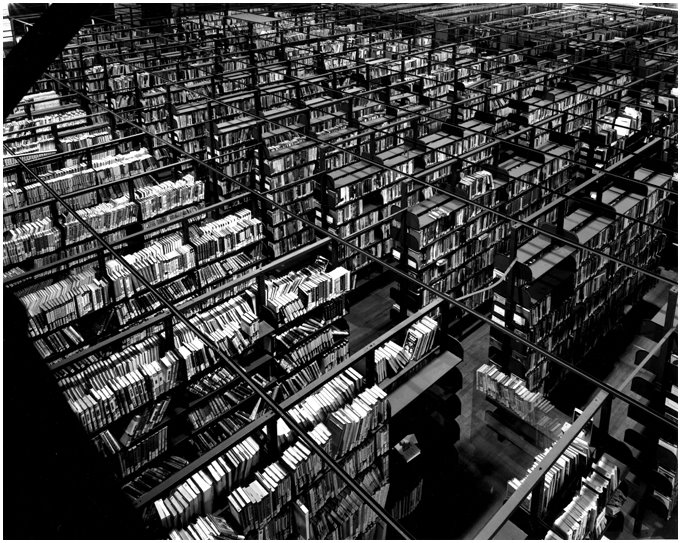
One of the beautiful photos accompanying the article, by Abelardo Morell.
It's apt title is "Book Stacks in a Very Large Space #1, 2001."
A sample from the article:
In short, the entire works of humankind, from the beginning of recorded history, in all languages, available to all people, all the time.
This is a very big library. But because of digital technology, you'll be able to reach inside it from almost any device that sports a screen. From the days of Sumerian clay tablets till now, humans have "published" at least 32 million books, 750 million articles and essays, 25 million songs, 500 million images, 500,000 movies, 3 million videos, TV shows and short films and 100 billion public Web pages. All this material is currently contained in all the libraries and archives of the world. When fully digitized, the whole lot could be compressed (at current technological rates) onto 50 petabyte hard disks. Today you need a building about the size of a small-town library to house 50 petabytes. With tomorrow's technology, it will all fit onto your iPod. When that happens, the library of all libraries will ride in your purse or wallet — if it doesn't plug directly into your brain with thin white cords. Some people alive today are surely hoping that they die before such things happen, and others, mostly the young, want to know what's taking so long. (Could we get it up and running by next week? They have a history project due.)
Incredible (did I mention that already?).
If you have not guessed, I am securely among the second group Kelly mentions, eagerly anticipating this universal library. Such a beautiful democratic vision.
Inevitable, too, as Kelly points out: whatever legal issues remain unresolved, "Whether this vast mountain of dark books [that is, books of unknown legal status] is scanned by Google, the Library of Congress, the Chinese or by readers themselves, it will be scanned well before its legal status is resolved simply because technology makes it so easy to do and so valuable when done."
(That last, ironically, is from a page currently unavailable in the online version as a result of some technical troubles—I hope for your sake, reader, the Times soon makes the end of the article available.)
Don't get me wrong, I love books (and they won't become obsolete, I should think--as Kelly points out, they are the most durable and most dependable medium for storing information, requiring no technology to use and consisting in good, sturdy paper). The possibilities both for scholarship and for making information available to any and all, however, that this universal library promises are magnificent. "Every book to every person," to again quote Kelly: beautiful.
Every book to every person.